



















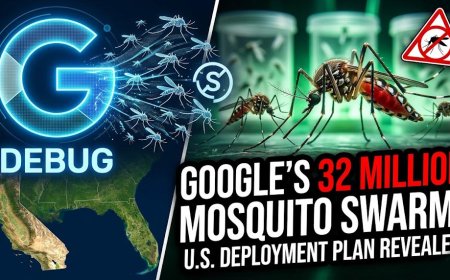






Google's Next Big Update? Releasing 32 Million Mosquitoes to 'Debug' the Wild

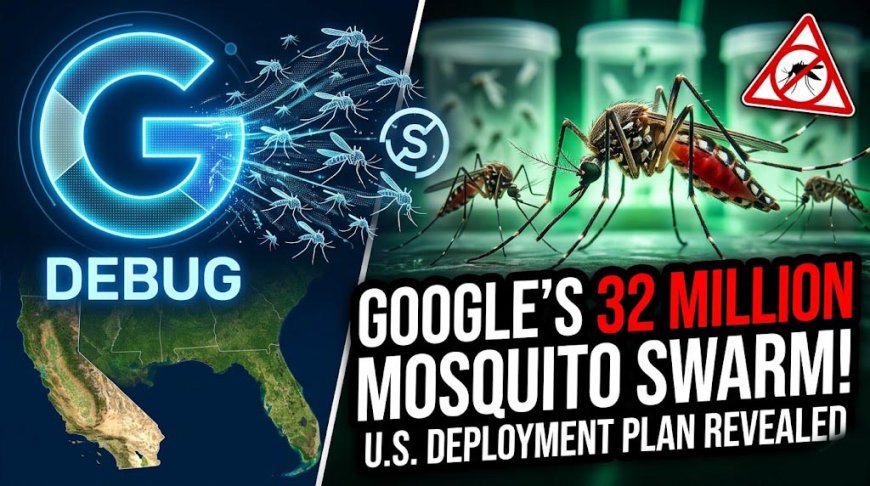
INTERNATIONAL DESK: In an unconventional blend of big tech and biology, Google has officially requested permission from the US government to deploy an army of millions of lab-reared mosquitoes in California and Florida.
The tech giant is utilizing its advanced AI and data analytics tools not to patch software bugs, but to suppress wild populations of the world's deadliest creature as part of its ongoing "Debug" initiative.
According to a
Fighting Bugs with 'Good Bugs'
The project focuses on a specialized biological strategy known as the sterile insect technique, a method scientists have utilized for decades to manage problematic pests. Google’s scientists are rearing male mosquitoes infected with a naturally occurring bacterium called Wolbachia.
Here is how the tech-driven solution works:
-
The Sterile Trap: When these Wolbachia-carrying males are released into the wild and mate with wild female mosquitoes, the resulting eggs fail to hatch.
-
Targeted Suppression: Because male mosquitoes do not bite or transmit diseases, the massive releases pose zero risk of increasing bites for local residents. Over successive generations, the overall insect population naturally shrinks.
-
Safer Alternatives: Google notes that traditional methods like chemical pesticides can be toxic to the environment and become less effective over time as insects build resistance.
AI in the Mosquito Factory
While using Wolbachia for pest control isn't entirely new, Google’s primary contribution is scale, automation, and tech infrastructure.
Rearing millions of fragile insects requires extreme precision. Google’s engineers are employing AI-powered computer vision and advanced sensors to build automated rearing systems. Crucially, the AI is trained to accurately separate the non-biting males from the biting females before any release takes place, ensuring they deploy the insects "in the right place and in the right numbers."
The Debug project—which originated under Alphabet’s life sciences subsidiary Verily before being fully absorbed by Google at the end of 2024—already boasts strong proof-of-concept data.
Proven Success in Singapore
The program's international research and development hub in Singapore has yielded staggering results. According to data from Singapore’s National Environment Agency, the sustained release of male Wolbachia mosquitoes achieved an 80% to 90% suppression of the target Aedes aegypti mosquito population. Furthermore, the trials led to a greater than 70% reduction in dengue incidents after less than a year of releases.
What's Next?
Because the Wolbachia bacterium regulates the insect population, the EPA treats the modified mosquitoes as a biological pesticide. The federal agency’s public comment period for Google's proposed experimental use permit closes today, June 5, 2026.
If given the final green light, local neighborhoods in California and Florida could see the first wave of Google's high-tech environmental "debuggers" take flight later this year.
What's Your Reaction?
 Like
0
Like
0
 Dislike
0
Dislike
0
 Love
0
Love
0
 Funny
0
Funny
0
 Angry
0
Angry
0
 Sad
0
Sad
0
 Wow
0
Wow
0